
Select and Prioritize AI Use Cases for Your Law Firm
Balancing value, feasibility, and risk
- Balancing value and risk: Selecting AI use cases that improve firm performance while managing accuracy, confidentiality, ethical, and regulatory risk.
- Aligning AI to strategy and maturity: Avoiding tool-led decisions by prioritizing use cases that align with firm strategy, workflows, and current level of AI readiness.
- Proving ROI under uncertainty: Justifying investment amid unclear efficiency gains, verification overhead, and evolving cost and security constraints.
- Driving adoption and capability: Overcoming cultural resistance and skill gaps to ensure AI is used safely, effectively, and consistently across the firm.
Our Advice
Critical Insight
Law firms underperform on AI adoption not due to a lack of ideas or tools but because unclear outcome metrics and underestimated cultural resistance drive tool-led decisions that dilute focus, slow adoption, and obscure ROI.
Impact and Result
- Produced a defensible, market-informed shortlist of AI use cases filtered by AI maturity, feasibility, and governance implications, creating clarity on where to invest now versus later.
- Built shared understanding across stakeholders of trade-offs, adoption barriers, and success conditions, enabling more confident, coordinated AI investment decisions.
Select and Prioritize AI Use Cases for Your Law Firm
Balancing value, feasibility, and risk
Analyst perspective
Embed AI with discipline, clarity, and human oversight.

Law firms are under increasing pressure to engage with AI as client expectations, competitive dynamics, and internal cost structures continue to evolve. While interest in AI adoption is widespread, progress remains uneven, shaped by the profession’s heightened sensitivity to risk, confidentiality, and accountability. Traditional law firm economics, rooted in utilization, pyramid firm structures, and billable time, create tension when AI promises efficiency without a clear mechanism for recognizing return on investment.
Concerns around output accuracy, explainability, data privacy, and regulatory exposure raise the cost of error and slow adoption. These risks often translate into verification overhead, governance friction, and cautious deployment, particularly when initiatives are not well aligned to legal workflows or firm capabilities. AI investment decisions are further complicated by feasibility factors beyond technical performance, including data quality, workflow suitability, and uneven adoption readiness across practices. At the same time, firms must navigate a rapidly expanding legal AI market, where overlapping tools, uneven maturity, and evolving vendor roadmaps make it difficult to place durable investment bets.
Importantly, AI use cases carry implications beyond efficiency alone. Decisions about where and how AI is applied increasingly influence talent attraction and retention, professional development pathways, client perception, and market differentiation. As a result, selecting and prioritizing AI use cases in law firms is less about generating ideas and more about balancing strategic value, feasibility, and professional risk in an evolving market.
Kassim Dossa, MBA
Research Director
Info-Tech Research Group
Executive summary
Your Challenge |
Common Obstacles |
Solution |
|---|---|---|
Law firms are under increasing pressure to use AI while protecting client confidentiality, managing risk, and remaining compliant from a regulatory perspective. Unfortunately, firms find it challenging to balance business impact, feasibility, and risk.
|
Firm leaders need to cut through the hype surrounding AI to optimize investments for leveraging this technology to drive business outcomes. The key barriers to success include:
|
Info-Tech’s human-centric, value-based approach is a guide for selecting and prioritizing AI use cases:
|
Info-Tech Insight
Firms struggle to select and prioritize AI use cases as they lack clarity on the metrics they want to impact and underestimate the cultural resistance to change in how value is delivered.
Your challenge
Build AI capabilities that protects clients and outcomes.
- Develop a business-capability-driven AI strategy that strengthens firm performance while minimizing investment, professional, and compliance risk.
- Placing risk-adjusted bets on AI tools that align with use cases, firm strategy, and AI maturity while balancing feasibility, ethical, and evolving regulatory constraints.
- Navigate the cost and security constraints of AI solutions while ensuring alignment with governance, privacy rules, and risk management standards.
- Uncover sustainable AI solutions in a rapidly shifting marketplace while resisting a tool-first approach to strategy.
- Address the need to upskill lawyers and staff to optimize productivity and resource allocation while delivering high quality outcomes and protecting client trust.
- Capture the competitive upside of AI implementation across talent, client acquisition, and brand differentiation while safeguarding the firm from avoidable risk.
74%of hourly work in the legal industry could be automated by AI.
Clio Legal Trends Report, 2024
Law firms that adopt AI with a clear, visible strategy are 3.9x more likely to achieve a positive ROI from their AI initiatives.
Thomson Reuters 2025
Common obstacles
Why your AI projects stall out:
- There are overriding concerns regarding AI tool accuracy, output verification costs, confidentiality, and reliability of outputs.
- Cultural inertia and AI-related knowledge gaps further reduce the firm’s willingness to consider more complex use cases.
- The pressure to keep utilization high reduces willingness and time available for upskilling, process redesign, and tool usage.
- It’s difficult managing concerns across ethical use of AI, model bias, and compliance in regulatory contexts.
- Successfully justifying the business case for AI initiatives, while understanding the true costs and risks.
74% of legal professionals are concerned regarding the accuracy of AI outputs.
American Bar Association Legal Technology Survey Report, 2024
81% of surveyed law firm clients and legal professionals are concerned that their firm might not protect their confidential information when using generative AI tools.
Integris, 2025
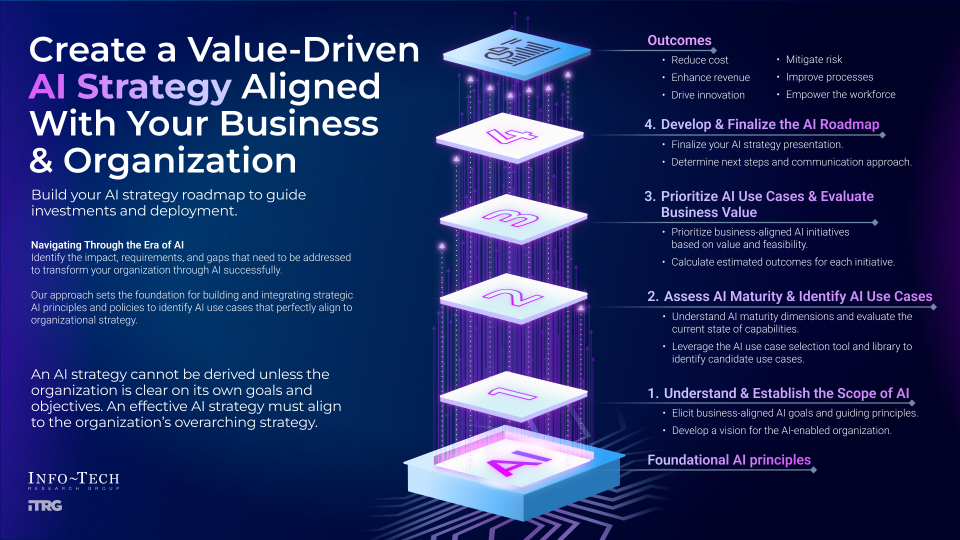
Select and prioritize AI use cases for your law firm
“We struggle to identify sustainable, business-aligned use cases amid vendor noise, unclear ROI, and heightened compliance risk.”
Challenges
- Entrenched billing and utilization models drive resistance to change.
- Low stakeholder confidence in AI outputs plus governance readiness.
- Difficulty in justifying business value vs. firm and individual risk.
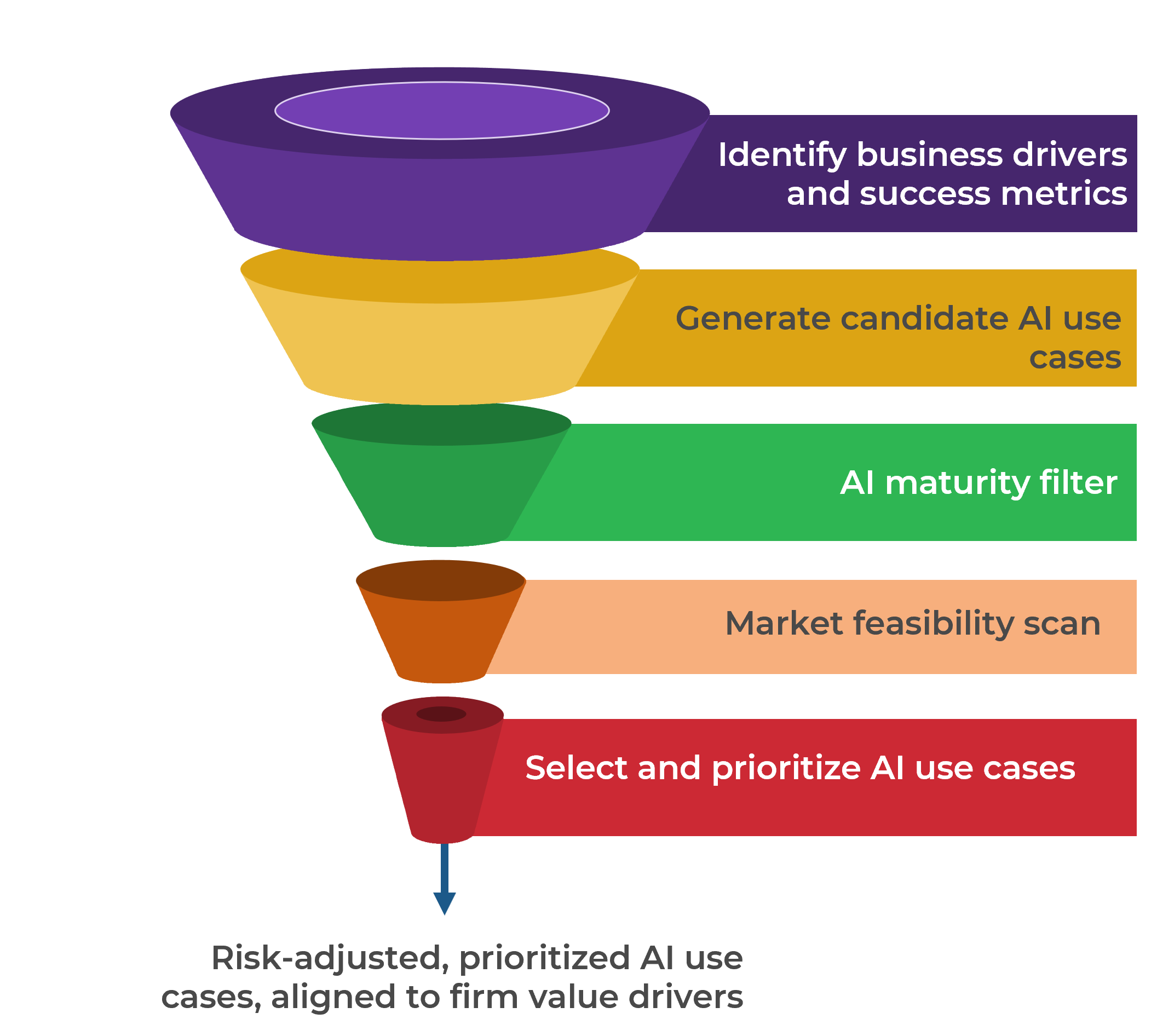
Workflow
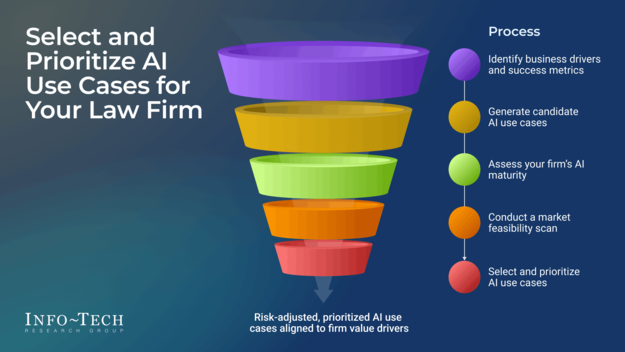
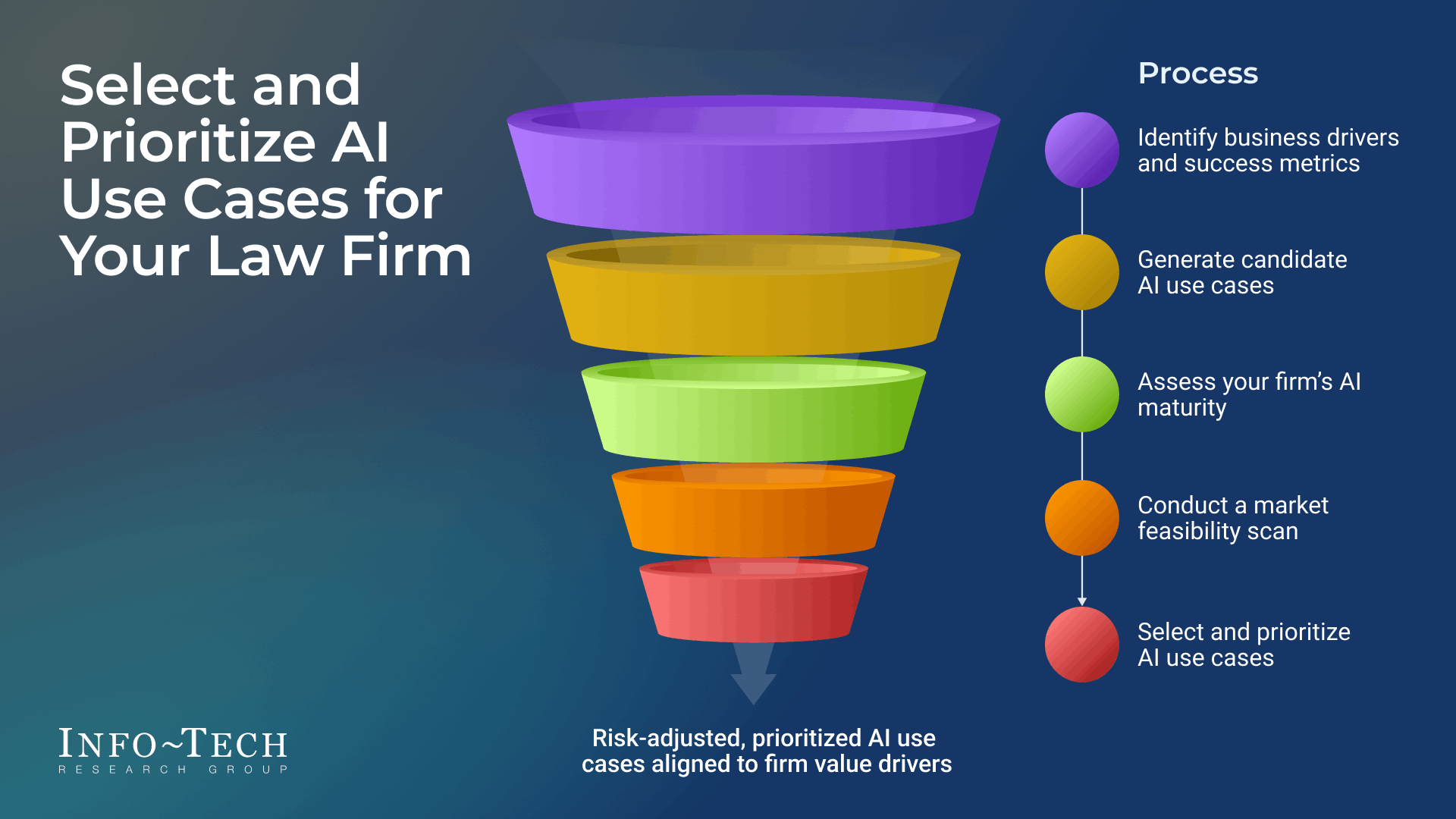
- Identify business drivers and strategic objectives.
- Generate a list of potential use cases aligned with key organizational units (i.e. litigation/transactional).
- Assess your firm’s AI maturity to further filter the use case list.
- Conduct a market feasibility scan to determine which use cases are supported by current AI capabilities.
- Evaluate remaining use cases and potential tools for their business value and feasibility to finalize the go-forward list.
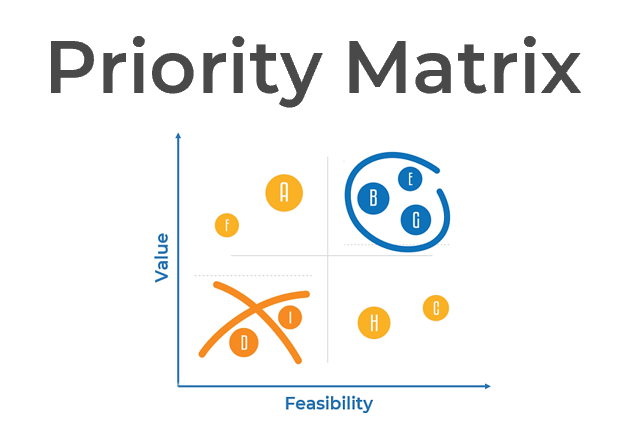
Building an AI use case list is easy. The real challenge is selecting feasible ones that fit your firm’s capabilities, align with key metrics, and suit your culture.
Outcomes
- Business drivers, success metrics, and cultural factor insight for AI adoption
- Clarity on AI maturity across technology, people, data, and governance dimensions
- Prioritized AI use cases by strategic fit, feasibility, and firm readiness.
Measure the value of this blueprint
Leverage this blueprint’s approach to ensure your AI use cases align with and support your key business drivers and speed up time to value.
With Info-Tech Resources |
Without Info-Tech Resources |
|||
Project Steps |
Time |
Average Cost (USD) |
Time |
Rationale |
Capability and Strategy Mapping |
0.5-1 day |
$7,500-$10,000 |
3-5 days |
Creation of a reference architecture and facilitation |
Use Case Generation |
0.5-1 day |
$5,000-$7,500 |
2-3 days |
Consultant facilitation |
Maturity Assessment |
1-2 days |
$5,000-$7,500 |
3-4 days |
Assessment development and facilitation |
Use Case Prioritization |
1 day |
$5,000-$7,500 |
2-3 days |
Scoring matrix and facilitation |
Effort |
3-5 days |
$22,500-$32,500 |
10-15 days |
|
Business Outcome Objective |
Key Success Metric(s) |
Revenue and Firm Growth |
Growth in new or existing revenue streams |
Client Value and Service Quality |
Client satisfaction and repeat work rate |
Legal Matter Efficiency |
Improved delivery speed, higher accuracy, and greater margin per matter |
Risk and Compliance |
Fewer incidents and reduced regulatory risk exposure |
Info-Tech offers various levels of support to best suit your needs
| DIY Toolkit | Guided Implementation | Workshop | Consulting |
|---|---|---|---|
| "Our team has already made this critical project a priority, and we have the time and capability, but some guidance along the way would be helpful." | "Our team knows that we need to fix a process, but we need assistance to determine where to focus. Some check-ins along the way would help keep us on track." | "We need to hit the ground running and get this project kicked off immediately. Our team has the ability to take this over once we get a framework and strategy in place." | "Our team does not have the time or the knowledge to take this project on. We need assistance through the entirety of this project." |
Diagnostics and consistent frameworks are used throughout all four options.
Guided Implementation
What does a typical GI on this topic look like?
| Phase 1 | Phase 2 | Phase 3 |
|---|---|---|
Call #1: Scope requirements, objectives, and your specific challenges. Call #2: Define AI vision statement. Call #3: Identify strategic principles. Call #4: Establish responsible AI guiding principles. |
Call #5: Assess the organization’s current state capabilities for managing AI. Call #6: Identify candidate business capabilities to be addressed by AI-based solutions. Call #7: Assess the value and feasibility of the AI business initiatives. |
Call #8: Prioritize the AI business initiatives. Call #9: Build a strategy roadmap. Call #10: Build a communication plan. Call #11: Build an executive AI strategy roadmap deck. |
A Guided Implementation (GI) is a series of calls with an Info-Tech analyst to help implement our best practices in your organization.
A typical GI is between 10 to 12 calls over the course of 2 to 3 months.
AI strategy roadmap – workshop overview
Contact your account representative for more information.
workshops@infotech.com
1-888-670-8889
This blueprint details the law firm’s treatment of sessions 2 and 3.
Pre-Workshop | Session 1 | Session 2 | Session 3 | Session 4 | Post-Workshop | |
Activities | Understand Business Strategy & AI Adoption | Establish Scope of AI Strategy | Assess Current AI Maturity & Identify AI Use Cases | Scan Tool Landscape & Prioritize AI Use Cases | Develop AI Roadmap | Next Steps and |
|
|
|
|
|
| |
Outcomes |
|
|
|
|
|
|
Blueprint deliverables
Each step of this blueprint is accompanied by supporting deliverables to help you accomplish your goals:
AI Maturity Assessment Tool
Use our best-of-breed AI maturity framework to analyze the current state of the gap between your current and target states.
Legal AI Initiatives Prioritization Tool
Assess and prioritize your legal AI initiatives that are aligned with your value streams.
Legal AI Use Case Library
Use our Legal AI Use Case Library to help inform your AI initiatives and approach.
Our AI Maturity Assessment Tool, AI Initiatives Prioritization Tool, and Legal AI Use Case Library enable you to shape your generative AI roadmap and communicate the deliverables to your C-suite sponsors in terms of the value of initiatives.
Stop! (please)
Consider the following before you proceed.
To be successful with this blueprint, complete the following before continuing with this deck:
- As this deck is only focused on the selection and prioritization of AI use cases for professional services organizations, please ensure you complete Phase 1 of the industry-agnostic Build Your AI Strategy and Roadmap blueprint.
- Review the Build a Robust and Comprehensive Data Strategy blueprint.
- While this blueprint contains a generic business reference architecture capability map, your outputs will be even more meaningful if you align the map with your specific firm. Instructions on how to accomplish this are found within the Legal Industry Business Reference Architecture blueprint.
Optional steps:
Key concepts
AI Vision Statement |
Strategic AI Principles |
Responsible AI Principles |
|---|---|---|
An effective AI vision statement is usually forward-looking and aspirational and reflects the organization’s commitment to leveraging AI to deliver positive and responsible outcomes. |
These guiding principles align the business strategy with the AI strategy and reflect the organization’s overall approach to the use of AI. Whether AI should be used or not and the decision whether to buy or build the AI application are examples of strategic principles. |
These guiding principles govern the development, deployment, and maintenance of AI applications to mitigate the possible risks from deploying AI-based applications. These principles also address human-based requirements that AI applications should address. |
AI Strategy |
Business Value Drivers |
AI Maturity Model |
A business-driven AI strategy is aligned with the organizational strategy of the firm. Key components of the AI strategy include:
|
These drivers represent how value is recognized by the organization and are used to ensure candidate AI initiatives are aligned to the goals and objectives of the organization. |
This model shows how an organization advances its AI capabilities across governance, data management, people, processes, and technology. |
AI overview
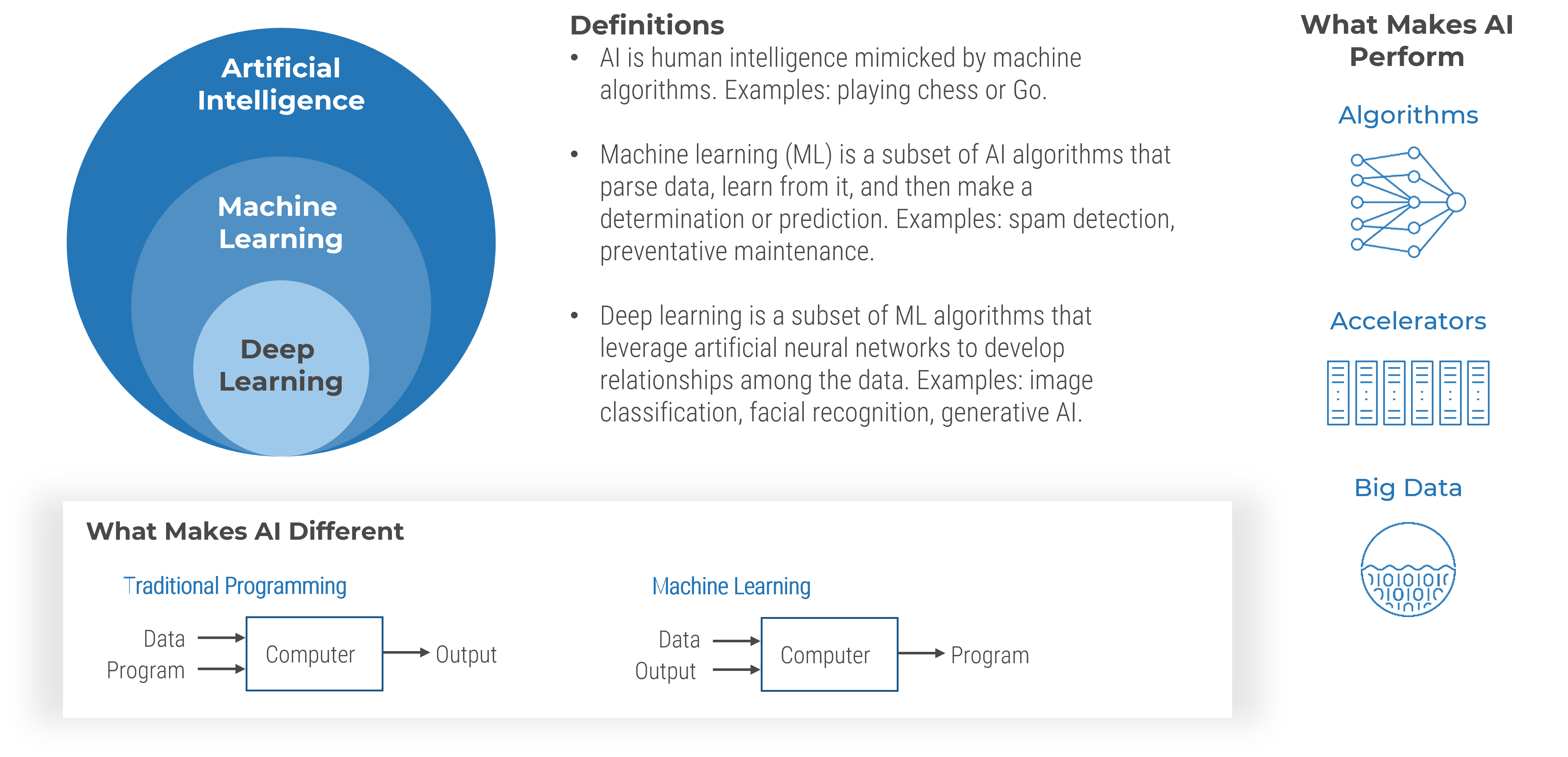
The risks with generative AI
Accuracy
May generate inaccurate and/or false information
Bias
Trained on data from the internet
Hallucinations
Responses generated that are not based on observation
Privacy
May not preserve data privacy
Cybersecurity
New threats targeting the AI model
Copyright
Possible IP infringement
Top industry-agnostic generative AI opportunities
Content Generation |
Accessing Enterprise Data |
Data Analysis |
Code Generation |
|---|---|---|---|
|
|
|
|
Phase 1
Understand Firm Capabilities and Candidate Use Cases
Phase 1 |
Phase 2 |
Phase 3 |
|---|---|---|
1.1 Map your candidate AI use cases |
2.1 Assess current AI maturity |
3.1 Conduct a market feasibility scan 3.2 Prioritize candidate AI use cases and build one-pagers for selected use cases |
This session will walk you through the following activities:
- Understand your business reference architecture and aligned firm capabilities
- Build a list of candidate AI use cases
This session involves the following participants:
- Executive stakeholders
- CIO
- Other IT leadership
Law Firm Business Capability Map
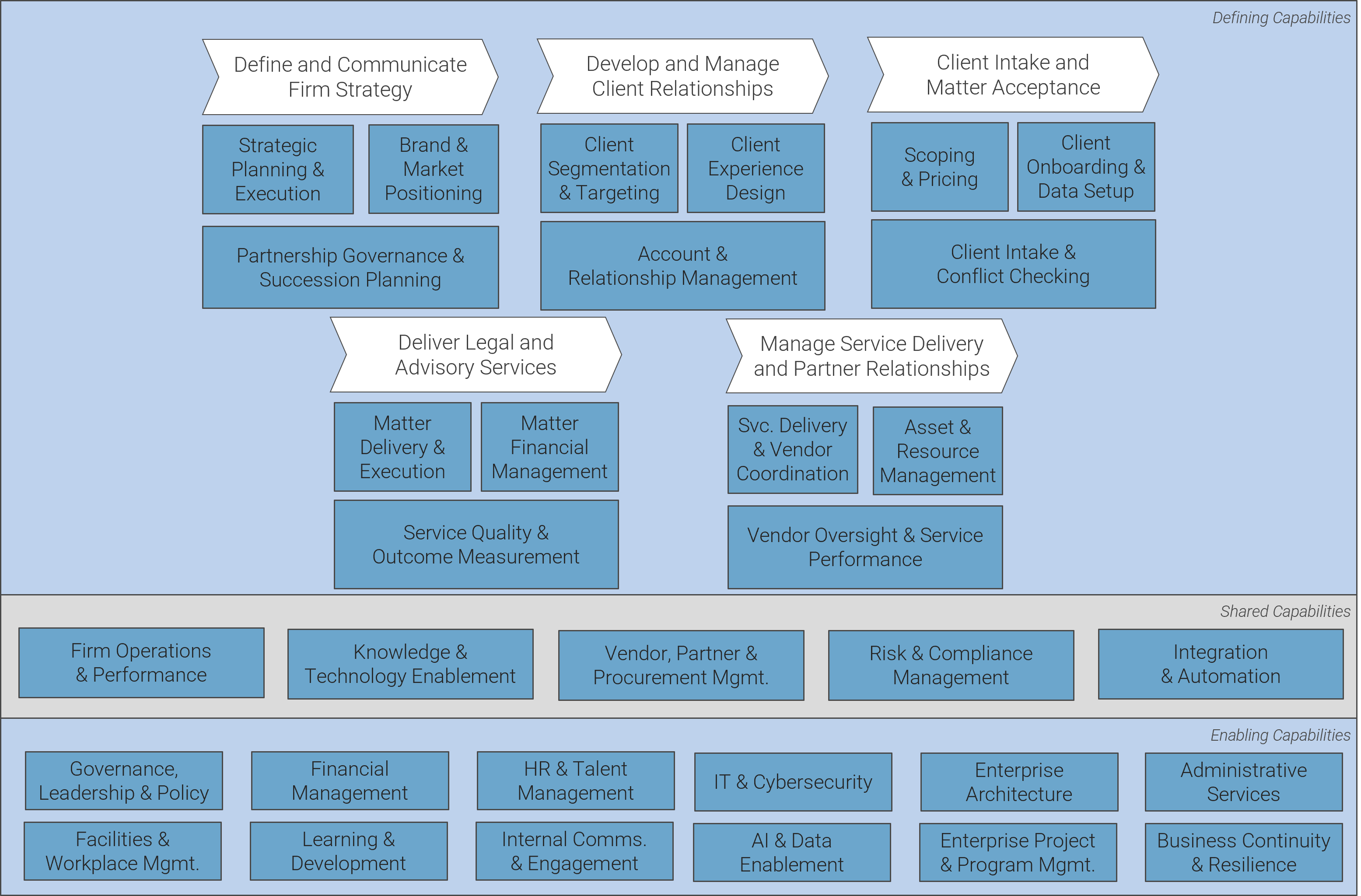
Business capability map defined
In business architecture, the primary view of an organization is known as a business capability map.
A business capability defines what a business does to enable value creation, rather than how. Business capabilities:
- Represent stable business functions.
- Are unique and independent of each other.
- Typically, they will have defined business outcomes.
A business capability map provides details that help the business architecture practitioner direct attention to a specific area of the business for further assessment.
1.1 Map your candidate AI use cases
- Gather the AI strategy creation team and revisit your strategy context inputs, specifically your organization's business goals, business initiatives, and business capability map.
- Brainstorm and discuss possible AI use cases your organization can leverage to bring value. You may use sticky notes or an online collaboration tool to keep track of your use case ideas.
- Next, detect possible challenges you may run into while implementing these use cases.
- Once you’ve mapped your candidate AI use cases, input this key list into your business goals to AI use cases cascade visual.
Download the Legal Industry Business Reference Architecture Template
Input |
Output |
|---|---|
|
|
Materials |
Participants |
|
|
About Info-Tech
Info-Tech Research Group is the world’s fastest-growing information technology research and advisory company, proudly serving over 30,000 IT professionals.
We produce unbiased and highly relevant research to help CIOs and IT leaders make strategic, timely, and well-informed decisions. We partner closely with IT teams to provide everything they need, from actionable tools to analyst guidance, ensuring they deliver measurable results for their organizations.
What Is a Blueprint?
A blueprint is designed to be a roadmap, containing a methodology and the tools and templates you need to solve your IT problems.
Each blueprint can be accompanied by a Guided Implementation that provides you access to our world-class analysts to help you get through the project.
Need Extra Help?
Speak With An Analyst
Get the help you need in this 3-phase advisory process. You'll receive 11 touchpoints with our researchers, all included in your membership.
Guided Implementation 1: Understand Firm Capabilities and Candidate Use Cases
- Call 1: Scope requirements, objectives, and your specific challenges.
- Call 2: Define AI vision statement.
- Call 3: Identify strategic principles.
- Call 4: Establish responsible AI guiding principles.
Guided Implementation 2: Assess the AI Maturity of Your Firm
- Call 1: Assess the organization’s current state capabilities for managing AI.
- Call 2: Identify candidate business capabilities to be addressed by AI-based solutions.
- Call 3: Assess the value and feasibility of the AI business initiatives.
Guided Implementation 3: Prioritize AI Use Cases
- Call 1: Prioritize the AI business initiatives.
- Call 2: Build a strategy roadmap.
- Call 3: Build a communication plan.
- Call 4: Build an executive AI strategy roadmap deck.
Contributors
- CJ Saretto, CTO, Axiom Law
- Bryce Berry, CIO, Norton Rose Fulbright – Canada
- Alex Bazin, CTO/COO, Lewis Silkin LLP
- Aly Dossa, Shareholder & Chair, Privacy and Security Practice, Chamberlain Hrdlicka